 Image 1 of 1
Sara Impey is best known as a maker of quilt art, but poetry is just as much a part of her. It is no coincidence that the earliest poem in this collection, “punctuation”, was stitched on a quilt which was exhibited at the Victoria and Albert Museum and is now in its permanent collection. In contrast to her quilting, Sara’s poetry has been more of a private matter, reaching an audience in the writing groups and poetry societies to which she belongs. The poem “Embroidery” won second prize in the prestigious Crabbe Poetry Competition, run by the Suffolk Poetry Society, in 2013. Two further poems have appeared in the annual Crabbe anthologies, and yet others have appeared in the publications of Poetry Wivenhoe.
After leaving Oxford, Sara trained as a journalist, became the second graduate employed as a reporter by the East Anglian Daily Times, and then the first woman on the parliamentary staff of The Times.
Through the years of bringing up her three children, she did not lose her interest in language and the way it is used and abused. This interest, especially in its political dimension, is now at the heart of her quilting, where the two main concerns of her work are: the thread that runs through human history of women who stitch; and how language serves political agendas in the post truth era. Her poetry reveals a gentler but no less serious involvement with the subtleties of language.
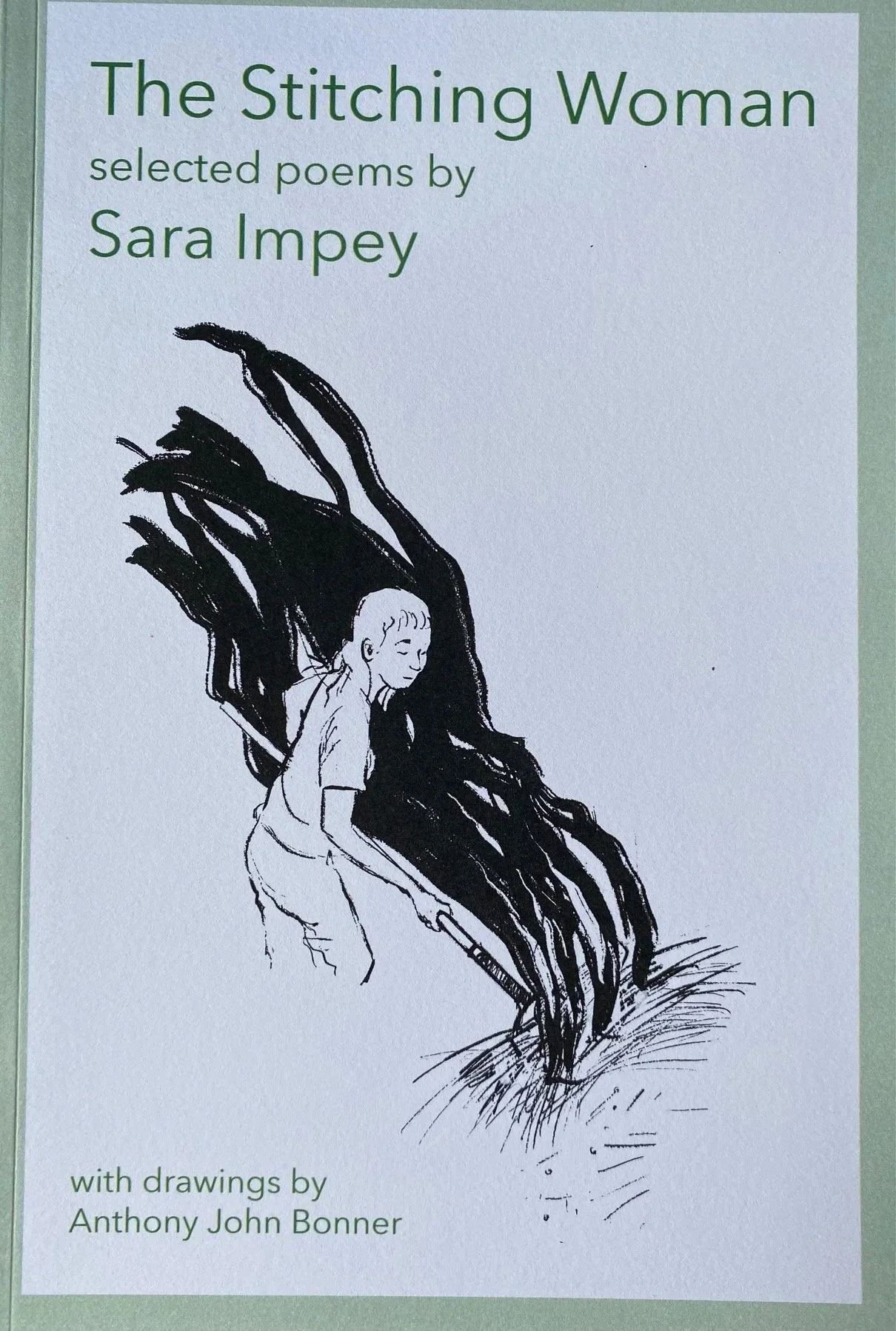
The poems in this selection are grouped in three sections. The first concerns Sara’s childhood in Feering, growing up on what was probably the last seed farm in Britain, with her brother, John, who provided the drawings for this book. The poems in the second section are lighter in tone, amused sideways glances at the absurd.
The poems in the third section explore her relationship to the place where she lives. Sara sometimes remarks that, apart from university and a work placement, she has never lived more than seven miles from where she was born. She walks every day beside the Blackwater, passing the mill where her parents lived before her birth, the abbey, all the familiar streets and buildings of Coggeshall, Kelvedon and Feering, and along the footpaths and lanes that link them, where she is among the ghosts not just of her farmer and miller ancestors and the people they dealt with, but also of the textile workers - the wool merchants, the silk weavers, the tambour lace makers - whose industry created this place, leaving us a legacy that matters, she maintains, and we should care for.
“This is a memorable expression of the ultimate limits of language” James Knox Whittet, judge of the Crabbe Poetry Competition 2013, writing about “Embroidery”